Structuring Success: How a Daily and Monthly Planner KDP Interior Enhances Real-World Productivity
For professionals, creators, and entrepreneurs, time is the ultimate resource. Its management, however, often falls victim to fragmented tools—digital apps for appointments, paper scraps for notes, and disparate calendars for long-term goals. This fragmentation creates friction, slowing down the very workflows designed to propel us forward. The Daily and Monthly Planner – KDP Interior is not merely a printable template; it is a unified architectural framework for your time. It functions as a dedicated workspace where daily execution and monthly strategy coexist, bridging the gap between immediate action and overarching vision.
Understanding the Planner's Core Structure and Function
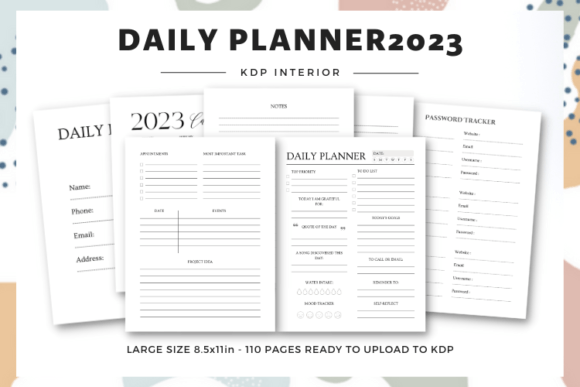
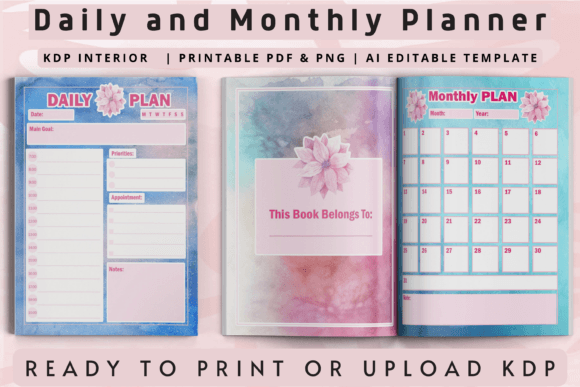
At its heart, this planner interior provides a cohesive system. The included 12-month calendars and the beautiful at-a-glance monthly spread view offer the strategic high ground. Here, you map out project phases, block out focus weeks, and mark critical deadlines. This monthly overview is the command center. It interacts directly with the more granular sections: the dedicated space for each day of the month and each week of the year. This is where strategy decomposes into tactics. You translate a monthly goal like “complete client proposal” into daily tasks: “research data on Monday,” “draft outline on Tuesday.” The structure forces a necessary and productive dialogue between your long-term objectives and your daily reality.
The design acknowledges that workflow is not linear. Hence, the integration of an Important Dates page, Projects Goals Notes section, and contact lists. These are not isolated appendices; they are interconnected reference tools. A contact noted in the dedicated section is the person you’ll schedule a meeting with in the daily appointment slots. A project outlined in the goals section is what you’ll track progress against in the weekly views. This internal synergy eliminates the need to hunt through different notebooks or files, creating a single point of reference for your operational life.
Integration into Professional and Creative Workflows
Consider a freelance graphic designer. Before a new client project, they can use the monthly spread to visualize the entire timeline, from kickoff to final delivery. They block out days for conceptualization, client reviews, and execution. Then, in the daily sections, they break those blocks into specific actions: “sketch three logo concepts,” “prepare presentation file.” The Projects Goals Notes section becomes a repository for client feedback and creative inspiration gathered during the process. The physical 8.5x11 inch page provides ample room for rapid sketching of ideas alongside written to-dos, a combination often stifled in purely digital tools.
For an educator or small business owner, the planner serves as a master log. The monthly overview can map out a curriculum schedule or a marketing campaign calendar. The daily pages then accommodate the unpredictable granularity of the day: student meetings, supplier calls, urgent emails, and notes for future improvement. Having the “at-a-glance” monthly view alongside the daily detail allows for quick adaptation. If a daily emergency disrupts the plan, you can immediately assess its impact on the monthly timeline and adjust subsequent days accordingly, maintaining overall consistency.
Practical Implementation: From Digital File to Daily Tool
The practical value of this Daily and Monthly Planner interior begins with its format. Provided as a PNG and a ready-to-upload PDF file, it offers flexibility. You can use the PDF to print a physical planner, catering to those who prefer tactile engagement for better focus and memory retention. The PowerPoint file allows for customization—you can adjust colors or add specific headers before printing, tailoring it to your personal or brand aesthetics. The “This Book Belongs To” page establishes ownership, making it a formal part of your toolset, whether for personal use or as a gifted item to a colleague.
Integration requires a small but crucial preparation step: deciding on its primary medium. If printed, pair it with a quality binder. If used digitally, the PDF can be opened in note-taking apps on tablets for a hybrid approach. Its compatibility stems from its simplicity—it doesn’t require proprietary software. Usability is enhanced by its clear, colorful premium interior pages which visually differentiate sections, reducing cognitive load when you switch from planning to reviewing.
Optimizing Long-Term Use and Quality Control
The true test of any productivity system is its sustainability. This planner’s design encourages long-term use through its completeness and organization. By containing the entire year in one coherent structure, it becomes a historical record. You can look back at previous months to analyze workflow patterns: where did estimates fail? Which weeks were most productive? This review becomes a form of quality control for your own processes. The consistent layout across all months reduces the learning curve and builds a planning habit, as each month operates under the same efficient rules.
For the productivity-minded user, the planner also interacts with other digital tools. It doesn’t replace them but complements them. You might sync major deadlines from the monthly view into a digital calendar for shared visibility with a team. The daily appointment section can be used to draft your schedule before inputting it into a digital app. The planner becomes the quiet, focused planning stage, free from notifications, where you think and design your time before executing it in the often more chaotic digital realm.
Observations on Efficiency and Cognitive Organization
A key observation from using such a unified planner is the reduction of “planning overhead.” When daily, weekly, and monthly views are physically adjacent, the mental effort to switch contexts is minimized. You don’t close one app and open another; you simply move your eyes across the page. This spatial continuity supports a more fluid thought process. Furthermore, the requirement to write things down—in the daily schedule, in the notes section—forces clarity and commitment. An ambiguous thought like “work on budget” must be refined into a concrete action to be entered, leading to more executable days.
The very colorful interior is not just aesthetic; it serves an organizational function. Color can be used intuitively to categorize entries—blue for client work, green for personal development, red for urgent items—creating a visual shorthand that speeds up review and prioritization. Over time, this color-coded system across the monthly and daily pages allows for a rapid assessment of balance and focus, ensuring one project or area of life isn’t unconsciously dominating your time.
The Planner as a Hub for Decisions and Learning
Beyond scheduling, this planner interior facilitates decision-making and learning. The notes section adjacent to goals can be used to log pros and cons for a business decision, tracing the thought process over days. For someone learning a new skill, the monthly view can chart a learning path, and the daily sections can log practice time and key insights. It becomes a logbook for growth. The interaction here is between the planner and your evolving knowledge; it captures the incremental progress that is often invisible in day-to-day chaos.
Ultimately, the Daily and Monthly Planner – KDP Interior fits into a broader process of personal and professional mastery. It is the concrete workspace where intentionality is formed. Before a project, it is the blueprint. During the project, it is the daily log and navigator. After the project, it is the review document. Its value lies in bringing coherence to the scattered elements of a busy life, providing a single, structured, and adaptable environment where your plans can reliably meet your action.