Unleash Creativity with Curve Style Maze Templates
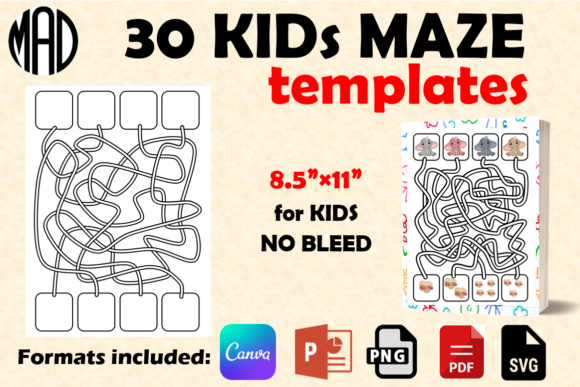
Imagine you’re crafting an activity book for children. You want engaging pages that challenge and entertain, but perhaps designing intricate mazes feels daunting, or time-consuming. This is where a structured starting point, like a collection of 30 Kids Maze TEMPLATES - Curve Style 1, transforms the process. These are not completed, themed mazes. Instead, they are foundational, hand-drawn “spaghetti-style” path frameworks provided in multiple file formats. They offer the skeleton—the winding curves and loops—waiting for you to add the flesh, the personality, and the final challenge.
What Exactly Are These Maze Templates?
This unique package is a toolkit for creation. It includes 30 distinct, artist-drawn maze paths, each with a clean, curved-line style. You receive these core designs in SVG, PNG, and PowerPoint PPT formats, plus a link to a Canva template. The critical detail is that the mazes themselves are open-ended; they lack predefined start and end points, internal decorations, or specific themes. They are the blank canvases of the maze world. The included bonus, a Maze Creation Tutorial, even guides you on how to create similar mazes yourself using tools like Inkscape, PowerPoint, or Illustrator.
The value proposition is clear: efficiency paired with individuality. You save the immense time of drawing the complex, interconnected paths, but you invest your creativity in finishing them. This means you can tailor a maze to a pirate adventure by adding ship illustrations, or to a space theme with planets and rockets. Two people using the same base template will inevitably produce two entirely different final pages.
Why Different Creators Approach Templates Differently
Your background, goals, and immediate needs dramatically shape how you might view and use this resource. A universal product like this serves multiple purposes, but not every purpose matters equally to every person.
For the Beginner or Hobbyist
If you’re new to designing activity pages, perhaps for a personal project or a small community event, your priorities are likely ease of use and confidence. The fear of “not knowing where to start” is real. Here, the templates eliminate the biggest technical hurdle: drawing a structurally sound maze. The multiple file formats mean you can use the tool you’re most comfortable with, whether it’s PowerPoint or Canva. The tutorial provides a learning path, boosting long-term usefulness. Your evaluation focuses on simplicity and whether the starting point feels manageable.
For the Educator or Freelancer
Educators creating custom worksheets or freelancers designing client materials often balance quality with speed. A hand-drawn template base ensures a professional, organic look compared to stark, computer-generated lines. The flexibility is key. A teacher can quickly adapt a maze to complement a current lesson unit—adding science vocabulary or historical figures along the path. A freelancer can efficiently niche it down to a client’s specific brand theme, ensuring reliability and a quick turnaround. For them, the commercial value and time saved are paramount.
For the Entrepreneur or Small Business Owner
If you’re publishing activity books or selling digital printables, your lens is commercial viability and scalability. Unique content is essential to stand out in a market. These templates offer a way to produce a high volume of base pages (30 is a significant start) that can each be made unique for different books or niches. The lack of a built-in theme means one template can be repurposed for a dinosaur book, a fairy tale book, and an animal book, maximizing the initial investment. Your concern is whether the tool allows you to create differentiated products efficiently enough to support your business.
For the Seasoned Creator or Professional Designer
Even experienced creators sometimes need a boost in productivity or a spark for creativity. You might appreciate the curated, hand-drawn curve styles as a design element you wouldn’t have sketched yourself, adding variety to your portfolio. The SVG format allows for deep, vector-level editing in professional software, offering total control. You might use them as a rapid prototype to test a book layout before investing hours in custom maze design. Your evaluation hinges on the quality of the base artwork and the flexibility the file formats provide for your advanced workflow.
Identifying If This Matches Your Project
How do you know if 30 Kids Maze TEMPLATES - Curve Style 1 is the right starting point for you? Consider your project’s stage and your personal constraints.
If you are at the very beginning, staring at a blank page, and need a structured way to jump in, this is designed for you. The templates provide immediate momentum.
If you have a clear niche—say, activity books for preschoolers—but lack the graphic design skills to create the actual puzzles, this package bridges that gap. You focus on the theme and decorations, not the maze geometry.
If time is your most limited resource, whether you’re a busy teacher or an entrepreneur launching a product, the pre-drawn paths reclaim hours you would spend on meticulous drawing.
Conversely, if you are a designer who enjoys and insists on crafting every single element from scratch, or if your project requires highly specific, non-curved maze structures (like grid-based logic puzzles), this might not align with your goals. The package excels in providing a creative foundation, not a final, themed product.
Practical Applications Across Fields
Let’s move from theory to practice. How might these templates actually be used?
A blogger creating free downloadable content for their audience could use the Canva link to quickly customize a few mazes with seasonal themes (a Halloween maze with ghosts, a spring maze with flowers), offering value to readers and enhancing their site’s engagement.
A small publisher planning a series of travel-themed activity books could use the PowerPoint files to drop the maze paths into their layouts, then illustrate them with landmarks from different countries, ensuring each book has fresh puzzles without redesigning the core challenge.
A parent making a custom birthday party activity pack could use the PNGs, add stickers and color, and create a personalized maze featuring the birthday child’s favorite cartoon character, turning a generic template into a memorable gift.
An online educator building a paid course module on problem-solving could incorporate these mazes as interactive PDF exercises, adding thematic elements that tie directly to the course content, thus enhancing the learning value.
The common thread is adaptation. The template is the constant; your creativity and niche are the variables. This separation of the complex structure from the themed decoration is what makes such a resource uniquely helpful. It respects your time while demanding your imagination, a combination that can benefit creators at nearly any level, from the tentative beginner to the pressured professional.