The Functional Appeal of a To Do Checklist Log Book
In a world saturated with digital productivity apps, the tactile simplicity of a physical planner remains compelling. A To Do Checklist Log Book represents a specific category within this space. It is not merely a notebook with blank pages; it is a pre-structured interior designed to capture, organize, and track tasks in a linear, accountable format. Its core distinction lies in its hybrid function: it combines the immediate, actionable clarity of a checklist with the enduring record-keeping utility of a log book. This creates a tangible audit trail of productivity, something many digital tools, with their endless scroll and easy deletions, cannot replicate with the same sense of permanence and reflection.
Understanding the Format and Its Key Features
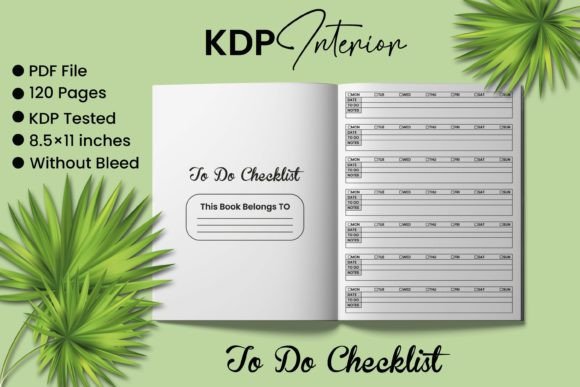
When evaluating a To Do Checklist Log Book, particularly one prepared for self-publishing platforms like Amazon KDP, certain specifications define its utility. A standard offering, as described in many downloadable interiors, includes an 8.5x11 inch format—a classic full-size dimension that provides ample writing space. The inclusion of both a PDF and a JPG file at 300dpi ensures the buyer receives high-resolution files suitable for professional printing. Typically, these interiors are structured with an introductory page and span a substantial number of pages, often around 120, offering long-term use without frequent replacement.
A critical technical point is that such an interior is often designed without bleed. This means the printed content is contained within the safe area of the page, with no graphics or borders intended to extend to the very edge. This is a practical consideration for creators who may be printing the book themselves or using a service that doesn't require full-bleed design. The entire package is compressed into a ZIP file, tested for KDP compatibility, and is ready for upload—a turnkey solution for entrepreneurs looking to publish a physical productivity tool.
Comparing Analog and Digital Task Management
The decision to use a To Do Checklist Log Book inherently involves a comparison between analog and digital task management systems. Each approach carries distinct strengths and tradeoffs.
A physical log book offers unimpeded, focused interaction. There is no notification pop-up, no temptation to switch apps, and no dependency on battery or connectivity. The act of handwriting tasks and checking them off can reinforce commitment and cognitive processing. For individuals who engage in deep work or who find screen-based planning distracting, this analog method can reduce cognitive load and increase task ownership. Furthermore, the log aspect allows for weekly or monthly reviews where past performance is visually apparent, facilitating honest self-assessment and pattern recognition.
Digital tools, conversely, excel in dynamism and integration. They allow for easy editing, recurring task automation, syncing across devices, and sharing with teams. They are searchable and can be backed up infinitely. For highly collaborative projects, rapidly changing priorities, or individuals constantly on the move between devices, a digital system is often more appropriate.
The Tradeoffs in Commitment and Flexibility
The choice between a bound log book and a digital app often boils down to a preference for commitment versus flexibility. Writing in a To Do Checklist Log Book is a deliberate act. Once a task is inscribed, it stands as a permanent record. This can be a powerful motivator for completion, but it also lacks the effortless reorganizing that drag-and-drop digital lists provide. The log book demands a linear, often daily, progression. Digital lists can be sorted by priority, project, or date with a few clicks.
Therefore, a To Do Checklist Log Book is best suited for individuals or workflows that benefit from a sequential, dedicated record. It fits scenarios where task lists are self-contained, where review and reflection are valued over constant rearrangement, and where the user prefers a single, authoritative source for their responsibilities that isn't subject to algorithmic changes or interface updates.
When a To Do Checklist Log Book Is the Right Fit
Identifying the ideal user for this tool helps in making an informed decision. A To Do Checklist Log Book often aligns well with certain professions and personal management styles.
For example, a project consultant managing a few key clients might use it to log discrete action items for each engagement, with completed tasks providing a clear history for billing and reporting. A student undertaking a long-term research project could use it to break down weekly milestones, with the log serving as a proof of steady progress. Individuals practicing mindfulness or intent-based productivity might find the physical act of checking off a handwritten list more satisfying and grounding than tapping a screen. In these cases, the book becomes not just a tool, but a artifact of the work process.
It is also a strong option for those who already use digital calendars for scheduling but want a separate, dedicated medium for purely actionable tasks. This separation of function—calendar for time, log book for actions—can create a cleaner mental model than trying to manage everything within a single, multifaceted app.
Scenarios Where Alternatives May Be Needed
Despite its utility, a To Do Checklist Log Book has inherent limitations that make other options more viable in specific situations.
If your task management is highly collaborative—you share lists with team members, delegate items, and need real-time updates on progress—a shared digital platform is indispensable. A physical book cannot provide this synchronous functionality. Similarly, if your tasks are exceptionally volatile, changing multiple times per day with dependencies and shifting deadlines, the static nature of a printed log can become a hindrance. The overhead of manually rewriting and reorganizing lists would outweigh the benefits.
Furthermore, for individuals with a strong need for accessibility or travel efficiency, carrying a full-size log book may not be practical. While the 8.5x11 format is excellent for desktop use, it is less convenient for mobile work than a smartphone app. In these cases, a hybrid approach might be considered: using a digital tool for capture and dynamic management during the day, and perhaps a weekly transfer of key completed items into a log book for archival and reflection purposes.
Evaluating Design and Usability Factors
When selecting a pre-designed To Do Checklist Log Book interior, practical evaluation points extend beyond the technical specifications. Consider the internal layout: is there a balance between space for lists and space for notes or reflections? Does the checklist design encourage prioritization, or is it a simple bulleted list? Some interiors incorporate priority columns, due date fields, or project headers, while others maintain a minimalist approach.
The choice here depends on your personal workflow. A minimalist checklist might suffice if your primary need is a clean, unfettered capture tool. A more structured interior with categories might be better if you manage tasks across different life domains—work, home, personal development—and want them logged in distinct sections. Reviewing sample pages, if available, is crucial to assess whether the layout's prompts and fields align with how you naturally think about your tasks.
Making the Final Decision: Key Considerations
To decide whether a downloadable To Do Checklist Log Book interior is the right resource for you, weigh a few final factors.
First, consider the longevity of the tool. A 120-page book represents a significant commitment. Are you prepared to use a single system consistently for that duration? If you frequently experiment with new methods, a smaller notebook or a digital tool might offer more flexibility. Second, think about the value of creation. Publishing your own log book using a KDP interior is an entrepreneurial act. It's suitable for creators, coaches, or businesses wanting to offer a branded physical product to their audience. If you are simply an end-user seeking a personal tool, purchasing an already-printed book from the market might be a more direct path.
Ultimately, the To Do Checklist Log Book occupies a unique niche. It serves those who value physicality, linear progress, and historical logging in their productivity practice. It is less a competitor to sophisticated project management software than a complementary tool for individuals seeking focus and tangible accountability. By understanding its structured format, comparing it to the dynamic nature of digital alternatives, and honestly assessing your own need for flexibility versus commitment, you can determine if this analog system will enhance your ability to manage tasks and achieve your goals.